
Welcome to the FSI Website
The purpose here is for any individual to have access to those historical and current ideas relating to individualism as a philosophy for living. The basic contention is that individual experience is the foundation upon which everything else is constructed. As suggested in the Descartes quote above, it all starts with the individual.
New—April 2021
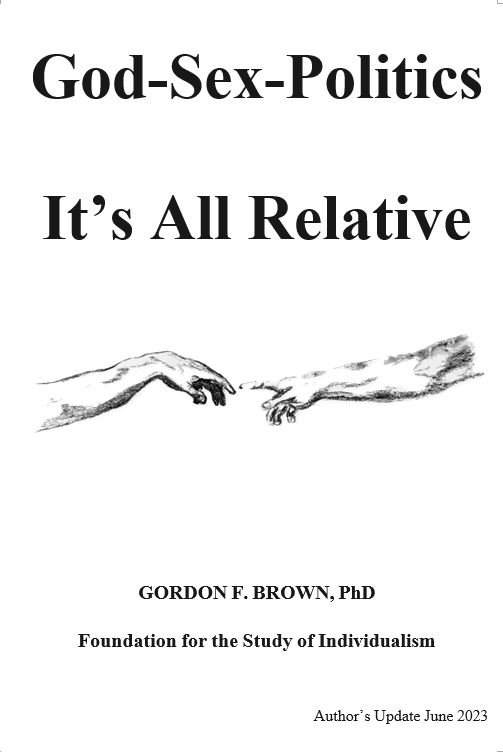
For the last 20 years, I have been compiling my research notes on individualism. God-Sex-Politics: It’s All Relative puts forth the thesis that, over the last 4000 years, individual dignity has been built on a foundation of relative thinking.
The book can be purchased on Amazon.com. If you would like to read it now, you can download it without charge by clicking here:
Best wishes,
Gordon F. Brown
July 12, 2026
Introduction:
You shall first love God and then love yourself as you love one another
(Mt 22:37, Jn 13:34). Five definition points can be seen: (1) you, (2) love,
(3) God, (4) self, and (5) others. Incidentally, these words attributed to
Jesus are cited, not because of any status attributed to him, but for the
reason that for thousands of years words attributed to him have been seen as
logically consistent with human experience. Consider the following commentary.
1. You
Being an adult human is primarily a matter of conscious awareness.
It’s all inclusive! One’s conscious awareness can be seen as distinguishing
between three distinct experiences—physical, rational, and those involving
choice (our P-R-C triad). Choices are primary in that they lead to
(a) physical experiences, that (b) become the ingredients for rational
thought, which (c) provides options from which to choose.
Choices can be seen as spiritual (not physical or rational constructions).
While choices are always private, their physical expression can become a
matter of public observation.
We do experience change. Conscious awareness is experienced
moment-by-moment or one-step-at-a-time. As for sequence, today’s
understanding is built on yesterday’s choices. When each day’s steps are
rationally combined, they form our concepts of change in terms of growth
and maturity.
Faith is the foundation upon which choices are made. As human
experience would have it, the future is unknowable whether it be a day,
a year, or a lifetime. Each step taken by an individual involves an act
of faith (outcome is unknown).
Self-evident is that life is an individual matter. Each of us can
see only into our own conscious awareness. Choices are made from options
seen as personally available.
2. Love
We have physical love such as caring for someone’s food, shelter,
and health needs.
We have rational love as when called out in contracts such as
marriage vows or when medical doctors take a Hippocratic Oath.
We have spiritual love when an individual seeks to find personal
integrity with someone or something. This involves thinking about and
sharing one’s conscious experiences.
3. God
God is a term used to refer to the Force that created or gave rise to
nature and human nature. This is not unusual. Virtually all observations
assume that something preceded or brought about what we now experience.
Some people awkwardly refer to this as “cause and effect.”
God is spiritual—not physically this or that, nor rationally
described as this or that. As one writer put it, God is spiritual
and referred to as the “I AM” (Ex 3:14).
To love God is to seek integrity with his creation. Such a dynamic
is similar to our observing another person’s behavior (speech and actions)
when seeking to interact.
4. Self
Loving oneself begins when an individual chooses to rely on his/her sensory
system and seeks integrity within the realm of human nature. It can be
understood that what one perceives is always through the lens of one’s past
experience. Trusting oneself is the foundation upon which personal
integrity is built. Doing so is widely recognized as a spiritual guideline
for living—as put forth in: Let each be convinced in his/her own mind
or To thine own self be true. It can be seen that self-interest
guides spiritual maturity. It’s a matter of each individual focusing on
that which is self-evident from moment-to-moment. However, as a function of
maturity, what is self-evident today may not be self-evident tomorrow.
Emotions can be helpful in that they alert an individual to the
effect of new experiences. Emotions are physical responses, and research
has demonstrated (Schachter) that they come prior to rational awareness.
Emotions act as gatekeepers to maintain personal stability. More
specifically, feeling positive indicates that one is being exposed
to ideas consistent with, and a consolidation of, one’s current thinking;
while feeling negative indicates that one is being exposed to ideas
that are inconsistent and destabilizing to one’s current thinking.
Here is a thought regarding change. We can contrast (a) comfortable
changes like those involving the growth of a puppy becoming an
adult; with (b) uncomfortable changes like those involved in the
maturation of a butterfly going from an egg—to caterpillar—to
pupa—to an adult. Notably, maturational changes are accompanied by negative
emotions in that they involve the destabilizing and stressful effects of
letting go of a known for an unknown. We can grow comfortably, but we do
not mature unless we choose to override our tendency to avoid negative
emotions. We must be able and willing to consider an idea that is
inconsistent with our current thinking.
Addressing cultural baggage is where seeking personal integrity
begins. As a child, our activities were directed by caregivers such as
parents and authorities such as teachers. However, a growing sense of
self-determination occurs at about 15 years-of-age. The individual
begins to see the freedom of making choices and observing the consequences
that follow. Similarly, Aristotle (360 BCE) put forth the idea that:
“It is the mark of an educated mind to be able to entertain a thought
without accepting it.”
By observing where one’s time is currently spent, an individual can
choose to modify the influence of childhood caretakers. Thus, maturation
involves having one’s spiritual choices guide one’s physical experiences,
while reason seeks to maintain integrity.
Life is a process where daily experiences are organized and
prioritized with the goal of finding those ideas that are more inclusive
of human experience.
5. Love Others
Our spiritual neighbors are a matter of personal choice. Freedom of
association is being able to say “Here I am” to all who indicate an
interest—as in the 1st Amendment to the Bill of Rights.
For many, it becomes self-evident that the behavior of one affects the
experience of all—be it a neighbor’s loud radio, a careless driver, or
(on the other hand) an encouraging word to a friend or stranger. It can
be seen that loving others is a matter of expanding one’s own self-interest
to include those having similar goals. As Jesus is said to have put it:
Share your ideas with everyone (Mt 24:14, Mk 13:10); but only spend time
with those seeking a relationship with nature’s God (Mt 10:14). However,
if a rejection is only at the physical level, do not reject them but simply
keep trying (Mt 5:39). Pushing the matter to its limits, Jesus reportedly
said: Be cautious about trying to put new wine into an old sack (Mt 9:17).
And again, do not cast your pearls to swine (Mt 7:6). The point here is that
choosing one’s spiritual neighbors (those with whom we spend time) is
fundamental to loving others.
Language is the link connecting individuals. It begins with finding
a common use of words (written or verbal). It can be observed that one’s
level of maturity determines what is said and what is heard by the
listener. Within this context, language can serve to increase integrity
both within oneself and with others.
Take note that language can be restrictive. The meaning of a word was
created by previous generations. Our words bring with them the cultural
thinking of their generation. Notably, just as language brought about our
current thinking, changing one’s language could be the first step in
changing one’s thinking—as in replacing “I must” with “I choose.” The
point is to choose words carefully and modify them to match one’s own
maturing experience.
Furthermore, we note that our choice of words is a task that cannot be
delegated to another. And, when someone describes a person or thing, it
says something about the speaker and not the observed. Others can share
what works for them, but only an individual can say what works for oneself.
All anyone reasonably can say to another is: Here is how I see something
or Here is how I understand what you are saying.
Historically, a significant other has been a belief in a God or Creator.
As for God’s creation, man can be seen as reflecting (in part) the
characteristics of the Creator. Thus, if man is primarily conscious
awareness, it can be seen to follow that the Creator would have the
capacity of conscious awareness as well. Additionally, if man is primarily
guided by choice, it can be seen to follow that the Creator would be guided
by choice as well. Such an idea can be seen as a basis for believing in a
uniquely spiritual interaction between the Creator and an individual—from
spirit-to-spirit (Jn 4:24). That is, the Creator could spiritually interact
with anyone spiritually choosing to do so. Reportedly, that was the gospel
of Jesus: Get by yourself and close the door when seeking a relationship
with God (Mt 6:6). It’s a spiritual, one-on-one interaction and essentially
unique to each individual.
CLOSING: (Read with or without parentheses)
Each individual (you) lives within a world of personal conscious
awareness. In life’s journey, we choose (love) from options we see as
available. We are all living within the realm of nature
(Creator/God). We choose (self) to either: (a) seek integrity
with an all-inclusive nature or (b) a world of our own making. Interacting
with others making a similar choice can contribute to our own maturity.
They too are part of human nature.
As attributed to Jesus, we have a guideline for living that puts forth the
idea that (a) there is a Creator who say’s Here I AM and (b) that
the best life is to be found when seeking a personal relationship with the
Creator’s creation (Mt 6:33, 7:11, Lk 12:31) by saying “Here I am.”
I anticipate the next posting within a month or so and titled
“Maturation—A Practical Guide”
January 25, 2026
A Walk with God
Introduction: We can begin the new year with Spring in mind along with expectations for new growth and maturity. Using the P-R-C (physical-rational-choice) triad, we have three gods to consider: the God of Jews as observed in our own interactions and recorded in the Old Testament; the God of Christians as put forth in the Bible along with countless interpretations during the last two thousand years; and the God of Jesus from statements attributed to him and cited in the New Testament. Generally, there is enough ambiguity in changing positions that definitions of Jew and Christian are left to local leaders and chosen by individual believers. As for the God of Jesus, since there are no records by him, all statements attributed to him are by others.
A. God of the Jews
Physical Primary Referent: The individual is defined in physical terms; specifically, one’s DNA connecting them to Abraham and thereby creating a physical group now known as Jews. Accordingly, there is the worship of one’s biological family and material success. Owning a business can provide control over income. Separately, Jews can be heard to say that they are a specific group chosen by God with special entitlements over other groups. Such a belief can be seen as creating a spiritual wall between Jews and everyone else. Fixed contracts between God and Jews are a matter of record. It is recorded that Jews praised God when successfully killing and taking the wealth of non-Jews. Notably, the Promised Land was a physical place rather than a spiritual insight. [As an aside, when Jews say “I am a Semite, it can be seen as a matter of smoke and mirrors. While some Jews may be Semites, most Semites are not Jews.]
Arguably, Jews have a history of rejecting personal one-on-one relationships between God and each individual (Exodus 20:19, Judges 8:22). Guidance was initially provided by the leader Moses (circa 1500 BCE). Perhaps “guidance” is too mild a term. Jews who rejected Moses’ guidance were put to death in the name of God (Ex 32:27). Later, as recorded in 1 Samuel 8:6 (circa 1100 BCE), the Jews demanded a king and specifically rejected a personal one-on-one relationship with God. After the period of kings (circa 1000 BCE) and to the present day, prophets and Rabbis tell Jews what to do regarding their relationship with God. As the Prophet Isaiah (Is 1:16) put it (circa 700 BCE): “cease to do evil, learn to do good.” To rationally offset short-comings, a goat may be sacrificed. The Old Testament can be seen as recording the history of Jews as they rejected a personal relationship with God. Perhaps it is in the book of Amos that some of the harshest criticism of Jews rejecting God can be found.
B. God of the Christians
Rational Primary Referent: As with all rational formats, you begin with a given and deductively organize ideas around it. Terms expressing certainty like truth and proven are common as when specific instances are seen as logically integrated into a given. One can frequently see that truth morphs into value terms such as good and evil—good to follow the truth and evil to follow that which is contrary to the truth. Claiming to have knowledge of good and evil can be seen to create a spiritual wall between those who embrace and those who do not embrace that which is good. The group called “Christians” was founded by Jews who believed that Jesus was the Messiah of the Old Testament. The Bible as interpreted by their leaders has become the basis for establishing beliefs, and said by the leaders to be the word of God. [As an aside, consider that “Christ” was a Greek translation of Messiah and not used in the Old Testament. It is the same when “Joshua” was translated as “Jesus.”]
A basic Christian tenet was the belief in one’s ability to discern good from evil. It’s perhaps ironic that the writer of Genesis (2:17) cautioned that doing so was the one-and-only thing that would separate an individual from God. Using the Adam and Eve story, the Christian message came to rely heavily on the Old Testament idea of sacrifice with Jesus becoming the sacrifice for everyone’s shortcomings. Rather then the Genesis idea (3:19) of “from earth you came and to earth you return,” the Christian idea of an everlasting hell for non-believers provided a cogent incentive when proselytizing to Jews and non-Jews alike. Salvation from hell can be achieved by repeating a few words in earnest and accepting Jesus as a sacrifice for your sins. Christians are a group with group beliefs put forth by their leader. Just as the Jew would say “I am a Jew,” the Christian would say “I am a Christian.” For Christians, larger groups suggest greater power, and greater power confirms that God is with you. It is with pride they speak of mega-churches and filling stadiums where hundreds are saved. Rather than the message of Jesus, the emphasis is placed on his birth, death, and equality with God.
C. God of Jesus
Spiritual Primary Referent: Jesus’ message was for each individual to seek a spiritual relationship with God (Mt 6:33)—it’s from spirit-to-spirit (Jn 4:24). Notably, an individual’s spiritual nature (conscious awareness) is always private, unique, and changing. Similarly, a spiritual relationship with God is necessarily private and one-on-one (Mt 6:6). The best life (physically, rationally, spiritually) is to be found when one has a belief in a personal relationship with God (Mt 6:33, 7:11, Lk 12:31, Jn 15:11, 16:24). Often using metaphors, Jesus described what one would experience if they turned directly to God (Mt 13:3, 13:24, 13:31). Jesus could be described as physically the son of man (Mt 9:6, 10:23, 13:37) and spiritually the son of God. Jesus’ focus was on the Jews (Mt 10:5, 15:24) in that they were egregiously being mislead by their leaders (Mt 5:20, 23:13, 23:27, Lk 9:22, 16:15). However, Jesus said that his Father’s house has many rooms some of which include non-Jews (Mt 21:43, 28:19, Mk 11:17, 13:10, 14:9, 16:15, Lk 4:43, Jn 14:2). As for priorities, if forced to choose between a spiritual relationship with God or one’s own physical life, Jesus would choose a spiritual relationship with God whether he physically wanted to live (Mt 26:39, Mk 14:36, Lk 22:42) or not (Jn 12:27). When they are in conflict, spiritual choices take precedence over physical benefits, or so it was with Jesus.
Jesus took special note that while he was physically here, he was the light of the world (Jn 9:5). However, when Jesus physically leaves this world, where he goes we can’t come (Jn 7:33, 8:21, 16:10). He told his disciples, to perform a ritual in his memory (Lk 22:19). After he was to physically die, there would be those who would seek him, and they would spiritually die along with those who used his name even when performing great acts (Mt 7:22). Others would die as they seek to find salvation by searching the scriptures (Jn 5:39).
However, after Jesus’ death, God would provide a counselor (Jn 14:16, 14:25, 16:7); so that all would be taught by the spirit of God (Jn 6:45). Similar to the idea of all being taught by God, Jesus instructed: do not call anyone on earth “father” or “Rabbi” for we have only one Father and He is in heaven (Mt 23:8). Only after individuals have heard and learned from God would each come to an understanding of Jesus’ message (Jn 6:44, 6:65). Arguably, a relationship with God’s spirit is essential, while a commitment to one’s view of Jesus is not (Mt 12:31, Mk 3:29, Lk 12:10).
As described by Jesus, the Kingdom of God can be seen as referring to those currently developing a personal relationship with God (Mk 11:22, Lk 4:8, 17:21). Consistent with the writer of Exodus, Jesus said not to judge (Mt 7:1, Lk 6:37). Rather than certainty, a relationship with God was always a matter of faith (a belief without a rational basis) beginning with a faith similar to a child where a lack of experience makes most efforts a matter of faith (Mt 13:31, 18:3, 19:14 Mk 10:15). Of those who begin such a relationship, most will fall away (Mt 7:13, 22:14, Lk 13:24). Some who hear the message are simply too set in their ways to change (Mt 9:16, Mk 2:22) or lack the necessary background preparation (Mt 13:5, Lk 8:5). Others chose not to think about religion when the topic arose as when distracted by the cares of the world (Mk 4:19, Lk 14:16). However, for a few, their faith will grow over time (Mt 13:31; Mk 4:31, Lk 13:18, 18:17) and some would even mature beyond what Jesus had attained (Lk 2:52, Jn 14:12). As for Jesus, he grew and matured over time, and did not begin his 3-year ministry until about 30 years of age.
As an aside, we can observe that, from the beginning of written history, some individuals and groups have set forth the primacy of the God-individual relationship. In 626 BCE we have Jeremiah (Jer 31:34) declaring that we shall all know God; Protestants such as Martin Luther (1517) argued that salvation was a matter between the individual and God; Society of Friends as founded by George Fox (1650) held that individuals were only taught by God, and thereby rejecting all earthly spiritual leaders; the Unitarian efforts such as Thomas Jefferson (1800) holding that his religion was a private matter only between him and God; and individuals everywhere who have a personal and private sense of connection with a Force in their daily lives.
CLOSING: Whether arrived at by science or common sense, consider that only when there is a general consensus and understanding that man is primarily spiritual rather than physical or rational will we be in a position to achieve peace and integrity within ourselves and with others. Spirituality leads to the primacy of the individual. As the U.S. Declaration of Independence (2nd paragraph) puts it: As a matter of human nature, every individual has a right to “Life, Liberty and the pursuit of Happiness.” And again, the 1st provision of the Bill of Rights provides for several interrelated rights with the first of these being the right of every individual to have the freedom of religion.
I anticipate the next posting within a month or so and titled “The Love Commandment.”
Milton Friedman
You are invited to look over “A Conversation with Milton Friedman.” This one-year, email dialogue between FSI Founder, Gordon F. Brown, and the noted recipient of the 1976 Nobel Memorial Prize in Economic Sciences focuses on linking a philosophy of individualism and the theory of free-market economics.
Ray Bradbury
New to this site is A Conversation with Ray Bradbury with Gordon Brown that began in 2007. Ray Bradbury (1920-2012) is a well-known and prolific American author of short stories and fiction with themes consistent with a philosophy of individualism–notably, Farhrenheit 451. [Posted on June 18, 2012]
Brown’s Perspectives and Commentaries
Visit “Brown’s Perspectives and Commentaries” for essays and reflections on a variety of topics related to individualism. Recent additions include:
* US-China Policy–Posted March 12, 2012, this commentary is an aside to my primary focus of writing a treatise that provides a bird’s eye view of individualism as a philosophy based on a relative perspective of reality. When shopping at Trader Joe’s, a casual comment to another customer about the virtues of organic bananas resulted in his mentioning that he was going to China. With China now on my mind, I decided to post on this website some of my thoughts where I consider US-China policy to be a part of a natural maturational process involving induction and deduction. As for putting this commentary on the website, I took note that although we do no advertising, there are over 2000 hits per month with China being a respectable second to US hits.
* Tiger’s Titantic –This commentary, posted December 20, 2009, on Mr. Wood’s current situation is viewed from a relative perspective and takes note of our newsletter in 2002, which can be seen as predicting a significant aspect of this episode.
*Herbert Hoover‘s American Individualism –This commentary, posted October 2008, explores the implications of Hoover’s philosophy of individualism.
“Relativity” is a term we frequently associate with individualism. Our use of the term simply refers to relationships as the basic dynamic underlying human experience. We have provided a link to a series of “Relatively Speaking” newsletters spanning over 25 years.
This is an active site with weekly additions and up-dates. Feel free to leave your comments using our Feedback link.